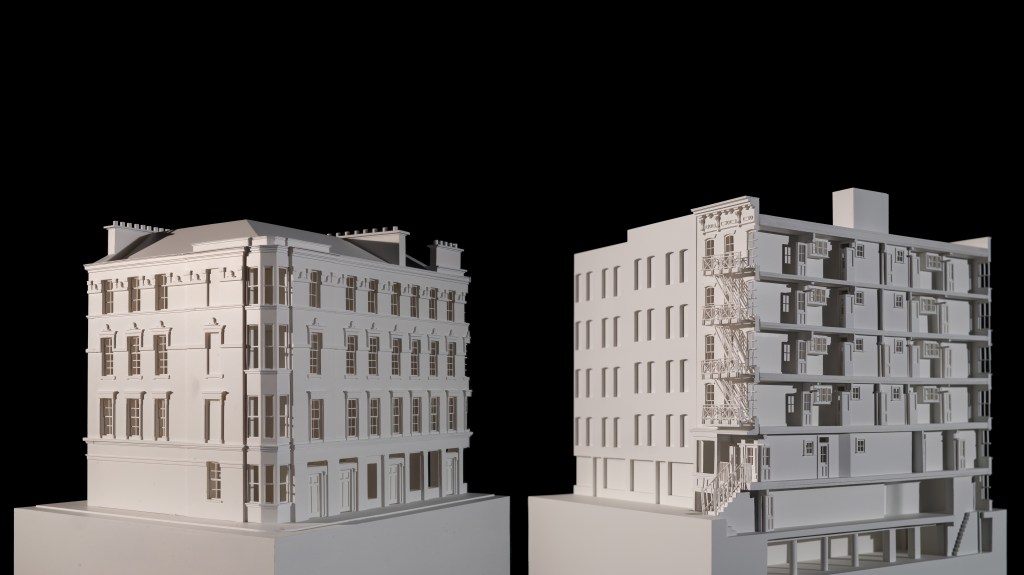
I visited New York for the first time on my year out and while exploring the Lower East Side of Manhattan I noticed the tenements there were drastically different to the ones found back home in Glasgow. The narrow six storey mid block buildings seemed to nearly a different species entirely, yet they shared the name tenement and were built at the same time and respond to the same issue: the mass migration of people to cities. For my Stage 4 dissertation I wanted to explore the similarities and differences between the tenements found in the two cities and why they would evolve to be so different.
THE RESEARCH
Getting the drawings for the model was tricky as I couldn’t get access to the New York City Public archives on my last visit and I couldn’t get in contact with Li Saltzman architects who had worked with the Lower East Side Tenement museum on its restoration. I therefore hired a personal assistant, Paul, for the day to go to the archives on my behalf, get the drawings I needed and digitise the files and email to me. Paul spent the day at the archives looking up the drawings, which were stored on microfiche, and scanning them to PDF files so that I could convert them into CAD plans. There is a difference between architectural drawing sizes between the US and the UK: the UK typically using the A1 page size which measures 841mm x 594mm while the American ARCH D measures 609.6mm x 914.4mm, due to America still using imperial measurements. I scaled the plans in CAD, using known measurements from the annotated dimensions as the reference points. The drawings I received from the Archives included the floor plans for each level and the front and rear elevation however there were no sections so I drew that from scratch, using the elevations to set out the internal floor heights.
I’d expected the drawings for Queens Park Terrace to be easier to obtain, as the Mitchell Library Archive is 10 minutes from my university, however the drawings were missing from the library catalogue. I relied on previous students thesis, the work of Gavin Stamp which included scaled drawings of the part of the building I was looking at and historic photographs from the Mitchell Archive. From these sources I was able to draw the elevations, plans and sections I’d need to build the model.
THE MODEL
To make the model I used a variety of techniques under the tutorage of Suzanne Dunscombe, one of the Art Schools model makers. I decided early on that the two models would be white so that comparisons could be made about their scale, form and detailing without the bias of their construction.
The elevations are made from laser cut acrylic with the layers laminated together. The detail of the facade is made from a mixture of laser cut acrylic and hand cut pieces of Foamex. The interior structure is primarily 3mm foamex with laser cut acrylic doors, internal windows and wall cabinets (for 99 Orchard Street). Where the materials are joined, laminated or where gaps occurred the model had to be painstakingly filled, sanded and refilled again to give it the high quality finish seen below. Each of the components was sprayed white to give them a uniform colour during assembly with the completed model receiving a final few coats before display.
QUEENS PARK TERRACE, GLASGOW
99 ORCHARD STREET, NEW YORK
TWO TENEMENTS
A COMPARATIVE STUDY OF 19TH CENTURY HOUSING IN GLASGOW & NEW YORK
2016
INTRODUCTION
Housing was one of the major concerns with the growth of the 19th century city as mass migration from the countryside and immigration resulted in rapid population increases in urban areas. Cities began to have to adapt to cope with these and the resulting issues of density.
New York and Glasgow shared many of these issues, both experiencing rapid population booms in the early 19th century due to immigration and had to find ways of densifying the city and preparing for further growth. They began by laying down a grid to address the expansion of the city limits which had up until that point been managed by local land owners.
The housing typology of choice for both cities was the tenement, as a way of moving from the timber built two storey ‘shanties’ of Manhattan’s lower east side and the slum dwellings of the dense inner city of Glasgow. The resulting tenement typology is strikingly different between the two cities. At a glance the monumental stone block encircling city blocks in Glasgow tenements look as though they achieve a higher density of dwellings per acre than the narrow, deep plan tenements common in lower Manhattan. The opposite is the case however as the Glasgow tenement rarely goes above four storeys the New York tenement spans five residential floors as well as a raised basement and a sub basement.
I want to explore the contributing factors to the differences in the design of the two tenements. How did the evolution of the expanding city effect their growth? How did housing reforms and changes to planning policy cause them to evolve over time?
The tenement in New York at 97 Orchard Street is the subject of a number of books due to the works of the Lower East Side tenement museum who have collected oral accounts of the building’s inhabitants and published them to help colour the visitors experience to the museum. Andrew S. Dolkart worked with Li Saltzman architects, who worked on the preservation of the building, on his “Biography of a Tenement House In New York City.” Dolkart’s work is comprehensive in his exploration of the tenement’s history through the oral accounts of previous tenants, archaeological evidence found during its restoration as well as archival work looking at census records to see who was living in the building at the time. He looks at the changes to building planning policy within New York but not in other areas or cities. He briefly references the Snow report from London in relation to the spread of disease in New York but doesn’t look at the type of housing prevalent in the UK to see if there were any similarities that could be drawn. Were the people immigrating to America from the UK bringing with them housing typologies and ideas?
I will use Queen’s Park Terrace as a contemporary Glasgow tenement for comparative purposes as the area in which it was built became renowned for its overcrowding. There are several books that reference Queen’s Park Terrace however not in the same exhaustive detail as Dolkart’s account of Orchard Street.
I will compare the two tenements directly through in depth studies of both the plans and sections but also 3 dimensionally through the creation of a set of models. These will help to compare the scale, internal organisation, circulation and relationship with the street. I will investigate the tenement at 97 Orchard Street through the survey drawings that were drawn by Li Saltzman Architects in 1996 and 2007, before the opening of the Tenement Museum, and use them as the basis for making my model. The drawings for Queen’s Park terrace will be based on the illustrations and elevations in “Alexander Thomson The Unknown Genius” by Gavin Stump and “The Life and Work of Alexander Greek Thomson” by Ronald McFadzean. There have been several dissertations that have looked at Queen’s Park Terrace before it’s demolition so the images from those will be used as references.
GLASGOW & NEW YORK
There were numerous push factors that lead to people making the Atlantic Ocean crossing to America. In Ireland during the 1840s and 1850s the primary cause for migration was the Potato Famine of 1845-52 which caused the starvation and death of nearly 1/4 of the country population. The majority of the population were small land owners, half of all farms were under six hectares, and the potato was the main crop to provide sustenance on such a small footprint. The blight, Phytophthora infestans, affected between a third and a half of the crop leaving tenant farmers unable to pay their land taxes. They therefore faced the choice of eviction or starvation, those that could afford to made the crossing to America, over 1 million people left Ireland in the years following 1845.
New York began in 1624 as the Dutch colony of New Amsterdam with the majority of settlement focused on the southern tip of Manhattan Island. The streets grew organically and this can be seen in the blocks south of Wall Street which stand out against the stark uniformity of the rest of the grid. The land to the north was a mixture of meadow, farm and marshland and was ideal for expansion.
This came during the start of the 19th century when New York became the most prominent port in the north east of America and the point of entry for those immigrating from Europe. The population of the city tripled in just 20 years between 1790 and 1810 and it was this rapid growth that lead to The Common Council, who governed the city, to commission a survey of the land north of the city and establish a grid that would support further growth. The survey was undertaken by John Randel Jr. and upon completion he produced three maps outlining his vision for the future of the city development.
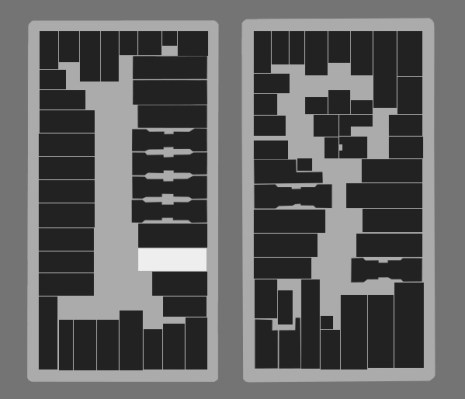
The grid as proposed would have avenues which were to be 100 feet wide, running north to south with 1st avenue starting in the west and with streets, 60 feet wide, running east – west starting where the current city limits ended and being numbered up to 155th street in the north. Each block would be between 610 and 920 feet wide between avenues and 200 feet between streets. The blocks were subdivided for sale into 25 feet by 100 feet lots which was to be a defining factor in the design of the housing in New York during the 19th century.
The grid established by Randel wasn’t the only grid on the island however, an earlier grid had been established in 1760 by De Lancey on his property, on what would become the Lower East Side. The grid he established ran parallel to the river so produces irregular street patterns when it meets the Rendal grid. The area was redeveloped several times in the century before the construction of 97 Orchard Street with the land accommodating traditional timber row houses and a Dutch church.
 The 1840s saw one of the first large scale waves of immigration into New York with the population increasing from 312,710 to 515,547, a large number of whom settled in the Lower East Side. The sudden influx of immigration caused a surge in demand for affordable housing, two storey row houses were sub divided, and where capital was available they were replaced by tenements. 97 Orchard Street was built during the American Civil War when construction in Manhattan was declining, in 1862 there were 2250 buildings erected yet in 1863 this fell to 1247 then to 755 by 1864.
There was a continuing trend in Manhattan for the wealthy and prosperous to move north as the city expanded to the next fashionable area. That area was the Lower East side during the 1820s however had moved to the area around Bond Street during the 1830s then onto Gramercy Park in the 1840s. The German immigrant population began to follow this trend towards the 1880s when they began to leave the tenements in search of larger accommodation with better services in the suburbs of Brooklyn and Williamsburg. It was this change in demographic that would cause Schneider to close his German Saloon and for Glockner to sell 97 Orchard Street in 1886.
The sudden wealth of housing stock was seized by the influx of Jewish migrants arriving in the 1880s from Eastern Europe. This trend continued and by 1903 the Tenth Ward was the most densely populated in the city with 69,944 people, 665 people per acre, and the most densely populated block was that on which 97 stands with 2,223 people living in just 34 buildings. It was during this time when demand for accommodation was at its highest that people worked out of their apartments in the textile and cigar manufacturing industries.
In 1924 the Johnson-Reed Act, a racially motivated immigration law, was enacted to slow the immigration of Jews, Italians and southern Europeans into America by limiting each nationalities immigration to 2% of its total US population in 1890, before large scale immigration had begun. This severely limited the number of new migrants settling in the area and with the older migrant population moving to larger apartments elsewhere the neighbourhood population declined steeply. The US census documents the population falling from 414,909 to 248,696 between 1920-30, the number of tenants in 97 reflects this with there being 101 in 1910 but after the Johnson-Reed Act only 56 people lived there by 1925.
The 1707 Act of Union established a free market between Scotland and England and began Glasgow’s rise to power as a mercantile city. Glasgow traded with the other ports in the British Empire, primarily in tobacco and sugar. The city mainly consisted of the lands to the north of the Clyde and the Gorbals village with the adjacent settlements being governed independantly..

There were several street grids established on the south of the river, Tradeston was laid out between 1790 and 1798 and Hutchesontown between 1790 and 1813. In 1802 James Laurie began a plan for a suburb with the streets named after the English nobility, Laurieston. Due to the conditions of the Scottish feu duty method of land development negated that the streets be made of 4 storey houses along streets of equal lengths.
Glasgow was ideally placed for its role as a manufacturing centre during the Industrial Revolution, with supplies of coal and iron close by as well as the river for transportation and ship building. The prospect of jobs was a major influence in people immigrating from Ireland in the aftermath of the potato famine and from the Highlands where the croft farms were being cleared in favour of the more profitable sheep herding. The population of the city doubled every 10 years during the middle of the 19th century and it was the demand for accommodation that led to the popularity in real estate speculation, building accommodation in the hope the hope that the population would continue to increase and occupy it. Laurieston became and attractive suburb with many tenements and villas being built by the mercantile classes of Glasgow.
It was Glasgow’s success as a centre of industry that ended the desirability of the new settlements south of the river. Weaving factories and engineering works opened in Tradeston and further west in Govan there were ironworks and the prevailing wind blew the smoke and ash into Laurieston. James Burn Russell, a Glasgow Government official for health stated, “Glasgow is well off in regard to all these general conditions of health except one – the air… Our air the most impure in the three kingdoms.” Respiratory diseases are common place and drove the affluent out to the West End, beyond the extent of industry where the air was cleaner, leaving area to those who couldn’t afford to move.
Tenement landlords frequently sub divided tenements further to increase their occupancy and thus rent, exacerbating the over crowding in the area. Many of the tenements were built cheaply to maximise speculative profits and residents were plagued with insect infestation and epidemics due to poor sanitation, an epidemic of cholera and typhus in the 1840s killed 4 in 100 people. As industrial growth increased in the late 19th century life expectancy fell with a woman in 1885 only expecting to live until she was 44, and a man until he was 31.
The area continued to decline until the 1950s and 60s when the Gorbals was part of a redevelopment scheme that focused on slum clearance and the improving of peoples perceptions of the area. In the 1980s the M74 motorway was built, further isolating sections of the city, and demolishing more of the areas heritage.
There are many similarities in how the city around Orchard Street and Eglinton Street influenced their form, the sale of the 25×100 foot blocks in New York and the requirement for 4 storey tenements in Glasgow dictated their design. Both areas also suffered due to inadequate government policy, New York reducing the immigrant population and source of income for local property owners as discussed later and in Glasgow where the improperly zoned industry drove people from the area due to the impure air.
99 ORCHARD STREET
The tenement at 97 Orchard Street was built in 1863 in one of the first neighbourhoods of tenements in a growing Manhattan and was inhabited continuously until 1935 and during that time was home to nearly 7,000 people. It’s gained significance within the Lower East side, which still retains many similar tenements, as it has undergone very little physical changes since it abandoned as a residential building in 1935. At the time of its construction buildings were poorly regulated and the resulting typology exemplifies the cramped conditions, density and overcrowding of the age.
The first tenements were built in Manhattan in the 1820s and over the next 20 years became the dominant housing type, both in custom built structures and in converted single family homes. By 1865, two years after 97 Orchard Street’s completion, the total number of tenements in the city had reached 15,309 and the population of the city was closing in on one million inhabitants. The grid had been established in 1811 however the majority of the growth was still focused on the southern end of the island and overcrowding was such that when the Council of Hygiene and Public health conducted a survey of conditions in the area they found that there were on average 7 1/6 families per building, a rate of 240,000 per square mile.
97 Orchard Street is one of the three oldest on the block and was designed and built by an unknown architect for Lucas Glockner, a German working class immigrant. Until mid 1865 there was no requirement to submit a building permit so official documentation about the initial construction is scarce however similar five storey tenements built after the rule was enacted indicate that the architect oversaw the construction as well as the design. Glockner was unusual in his occupation of the tenement after its construction, he had moved his family from a smaller row house into the tenement and lived there for a few years, in contrast with the standard at the time where builders sold the tenement quickly after its construction and left long term rental income to land owners. One of the neighbouring tenements at 99 Orchard Street was sold after just 5 years.
Architects operating in the area at the time were most likely German immigrants themselves and exclusively men, having trained as builders or having studied architecture in Europe before crossing the Atlantic. The job didn’t entail as much creativity as is seen today in the facades and interiors of the buildings, the architects would visit the manufacturers and foundries directly for the purchase of window lintels, railings and cornices and base their design around them. The pieces were so standardised that the apartment at 99 Orchard Street is near identical on the street facade.
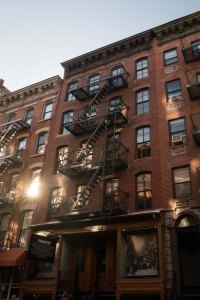
The tenement is 5 storeys tall, measuring some 17 and a half meters from the street to the top of the Italianate cornice on the facade, on top of a raised basement and sub basement. The raised basement accommodates two store fronts and were originally accessed by a wide staircase that led down to the shop door and window display. The cast iron staircase to the first floor entrance we see today was a later addition and the original would have been a steep stone stoop as seen elsewhere in the Lower East side. The street facing facade is of red brick with simple arched brownstone lintels over the double hung sash windows, which were painted white. The cornice at the top of the facade appears to be made of the same brownstone as the window lintels however is actually painted metal, with sand having being applied to the mixture to give the appearance of stone, reducing the construction cost. The cornice is another example of the item readily available from builders yards that the architects would have focused their designs around.
The rear of the tenement faced onto an enclosed yard and was accordingly simple, common brick and mortar with simple rectangular windows and projecting sills. There was a wooden staircase connecting the first floor to the rear yard which would have provided to the outside latrines. On the basement level a second exterior door provided access for the commercial accommodation to the rear yard where the fire hydrant was situated.
Fire was a major concern in tenement design as can be seen on the front and rear facades with the exposed fire escapes. On the front facade is an early fire ladder where the ladder connects each floor with a near vertical pitch. On the rear facade is a simpler iron balcony that joined with the adjacent property to provide escape.
Inside the tenement provided twenty apartments over five floors when originally built in 1863, with a central circulation core and the apartments surrounding it and each sharing half the facade on that level. The result was that the interior rooms got little natural light, a fact that was the focus of numerous changes to the fabric of the building due to changes in planning laws. Despite being available at the time of construction, Glockner did not install gas lighting due to the additional cost to the construction. Each apartment consisted of three rooms: a parlour; a kitchen and a bedroom. At the time of construction the building had no internal water supply so water for cooking and toilet facilities were outside.
In 1905 97 Orchard Street was remodelled extensively to address the changing demographic within the neighbourhood and to comply with new laws regarding sanitation that had came into effect. The first floor of the tenement was converted from apartments into more commercial accommodation, this saw the external addition of the projecting store fronts and the removal of the stone stoop. On the second through fifth floors the two apartments on the south of the building were altered to accommodate two indoor latrines that were to accommodate the four apartments on each floor. Indoor plumbing was installed throughout the building so the interior size of the kitchen was increased to accommodate a soapstone tub sink. Behind the newly installed bathrooms was a light well, designed to bring light deeper into the plan of the building, as the bedrooms were two rooms away from an exterior wall. The kitchen wall leading into the parlour was also remodelled with the addition of an openable window to increase light and ventilation into the interior.
In the early 20th century the population of the lower east side reached its peak, with people living and working out of the apartments within 97 Orchard Street. Many of those living on Orchard Street at the time were Russian Jews, many of whom worked in the garment industry, so each day an apartment would be transformed from house to work place to make the most of natural light which was best for sewing. At some point after 1918 electricity was installed in the tenement although electric lighting wasn’t installed in the common hallway until around 1924, according to the account of Josephine Baldizzi, a resident at the time.
It was largely down to the control of immigration that led to the decline of the population of the Lower East Side. In 1924 a restrictive law, set in place to control the immigration of Jews, Italians and Eastern Europeans was enacted, the Johnson-Reed Act which established an upper limit to how many of each nationality could enter the US in a given year, equal to 2% of its 1890 total which was before mass migration from these areas had begun. The result was a significant reduction in the new immigrants settling in the Lower East Side. Those that had settled there and were employed in the garment industry benefited from unionisation and wage increases and so moved to more affluent areas north or in the suburbs. The population in 1900 was one hundred and eleven, but by 1925 only fifty-six people lived at 97 Orchard Street and half of the apartments were empty.
Lower rental incomes led to property owners being unable to keep up with new requirements for tenement laws. In 1935 the tenement was owned by Moishe Helpern, and after a law was passed in May of that year, requiring the removal of all wood in public corridors and stairways, he chose to close the upper storeys of the apartment building as he could not afford to upgrade the staircase to something less combustable than pine. The basement and first floor remained in use as as commercial accommodation for the next few decades and the building was cared for by Fannie Rosenthal, a resident who remained in the caretakers apartment. 97 Orchard Street remained with the Helpurn family until 1988 when it was acquired by the Lower East Side tenement museum.
QUEENS PARK TERRACE
Queen’s Park Terrace is in contrast with 97 Orchard Street in that the architect of the scheme is known for a wealth of projects throughout the city. Alexander Greek Thomson was born in Balfron, a village in the north of the city, where he was home schooled, and it was his rural childhood that taught him about the natural world, a theme that would continue through many of his works.
He was an apprentice to Robert Foote architect who had traveled through Europe and had a particular interest in the Geeks and other works of classical antiquity, which he passed onto Thomson. He started work at another firm owned by John Baird, where he worked mainly alongside another architect preparing construction information with limited design input. During this time he read extensively in classical literature and architectural theory but never traveled outside the United Kingdom.
He established his own practice with his brother in 1856 and embarked on the period of work that would produce his most notable buildings. He worked on several tenements before Queen’s Park Terrace and reused and refined building elements in his later schemes first employed on earlier projects.
355-429 Eglinton Street, more commonly known as Queen’s Park Terrace was Thomson’s largest tenement and the one that would give him most lasting recognition. It was designed for a local builder, John McIntyre and two quarry masters; De Hort Baird and Alexander Stevenson and built in two stages. The northern most section, looking onto Devon Street, was constructed in 1857 with the south being completed later in 1858. The two pieces differ only slightly in plan with the staircase serving the corner of Eglinton and Devon Street being oval and the south eastern corner being round.
The tenement was bought by compulsory purchase order by Glasgow City Council and left to decay in the late 1970s until it was declared dangerous, despite there having been several plans made for its restoration. It was eventually torn down on St. Andrew’s Day in 1980 in an act of “self-defeating vandalism” to make way for part of the M74 motorway.
THE FACADE
 Queens Park Terrace rose 4 storeys above Eglinton Street, as dictated by the freu on the land when purchased, and consisted of two main parts, the simple shop fronts at ground level and the blonde sandstone accommodation above.
The shop fronts at ground have a continuous band for signage sitting on top of square piers that kept the continuous look appropriate for a tenement that encircled half a city block and are topped with a simple pseudo-Tuscan capital. The doors have been designed to seem as though they have been constructed of masonry and are recessed into the wall in a manner similar to that of the false stone doors in Egyptian tombs. Thomson also designed the gas lighting fixtures for the street further demonstrating his holistic approach to the design of his tenements.
The north, south and west facades face onto Devon, Eglinton and Turrif Street respectively. The first floor windows are set on top of a projecting cornice with square pilasters flanking the window and capped with a simple entablature above, carved with honeysuckle.
On the second floor the windows have a slightly projecting sill and lintel that is made of a continuous string course that joins each otherwise isolated window in a zig- zag pattern. The string course is decorated with small discs representing the paterae found in Etruscan and Greek culture. The course is finished with a simple acroterion that is repeated on the floor above.
The windows of the third floor are connected via a continuous string course at sill level with dwarf columns flanking each window with a recess between sheltering a centred acroterion. The window sits further back in the facade creating a sense of depth within the composition. An ornamented stone cornice skirts the top of the street elevation with the chimney stacks sitting atop decorated plinths above, Thomson often used chimney stacks as a design feature.
The corner of the tenement where Eglinton Street meets Devon Street on the North-West side would have originally have been similar to that of the south, a chamfered corner with the windows and string course continuing round to the next elevation, however it was altered at a later date to be a slightly recessed three-window bay that is concave in plan and reminiscent of the Roman Temple of Venus at Baalbek in Lebanon.
The East elevation facing the back courtyard of Queen’s Park Terrace is in stark contrast with the highly ornamented street facing facade as it is of rough masonry with the only ornamentation being a slightly projecting sill at each window. The inconsistency could be explained on economic grounds as the rear court would not have been visible to the public and not worth the expense of carved stone.
 97 Orchard Street is built in a simplified version of the Italianate style which was the most popular in the 1860s, though other buildings used more expensive materials such as brownstone for the row houses of Brooklyn and cast iron and marble for the commercial palazzi of 5th avenue. The 5 floors, as of 1863, of residential accommodation sit atop a raised commercial basement which had two timber storefronts flanked by cast iron piers and were painted to look like golden oak. The basement storefronts, which were visible from the street, were accessed via two sets of wide stairs.
The street facade had 5 bays of segmental arched windows, each ornamented with a slightly projecting brownstone sill and lintel. The windows are a double hung sash that would originally have been painted an off white cream. Crowning the tenement and projecting out over the street is an iron cornice that has been painted to look like brownstone, with the application of sand while still wet to achieve the effect. This kind of detail, along with the windows, sills and lintels were readily available directly from the manufacturer and thus relatively inexpensive to purchase and would have been a driving factor in the tenements design.
The most striking feature of the facade is the “fire ladder” the fire escape as required by the 1862 Tenement Act. The ladder employed is a near vertical staircase, thus the name ladder, that would allow residents to escape down the front facade and onto the street below via a series of descending ladders however these could be perilous to the young and old and were widely condemned by tenement reformers, eventually leading to their ban in 1901 although those already implemented were permitted to remain.
The rear facade is much simpler than the front with a simple common brick and mortar rain screen with simple square brownstone lintels and sills over square windows. The fire ladders on the rear facade were accessed via a party wall balcony, a balcony that links the windows of those in 97 with those to 99. In the even of a fire residents would escape by climbing out onto the balcony and escape through the apartment windows of those at 99 and was a common design feature in tenements whose adjacent neighbours shared similar floor heights.
The 1862 Tenement Act also required a means of scape from the front to the back of a tenement via a small internal door between apartments, located in the internal bedroom. The doors were extremely narrow, only 600mm wide and must have been almost impossible to use as an escape route as the tiny bedrooms would have to be cleared of furniture before they could be opened, some owners even fashioned home made locks for them. It is unsurprising therefore that by the 1870s 6,000 people a year were dying in tenement fires.
Escape by the the fire ladders was also often encumbered by the tenement residents, doing so was illegal but lately ignored and they were frequently used as an extension of the apartment for items such as wash basins, barrels and for the airing of mattresses. The New York City Fire Department concurred with, “the work of the firemen in rescuing tenants is often impeded by such encumbrances.”
The facades of Queens Park Terrace and 97 Orchard Street are strikingly different but can be attributed to the site they occupy. Queen’s Park Terrace has to address three street facing elevations in addition to a back courtyard while 97 Orchard Street only has one street frontage and a rear yard. The continuos oscillating of the string course on Thomson’s facade is appropriate for a frontage that continues around three sides of a block. They also differ in the how they were designed. As discussed the facade of Orchard Street was made of readily available components from local suppliers while Thomson’s facade was entirely individual, being all of uniquely carved sandstone. This can be explained on economic grounds as Orchard Street was designed on a budget, by immigrants for immigrants during the Civil War when capitol and building supplies were scarce. Queen’s Park Terrace conversely was built during the boom years when Glasgow was the second city of the Empire, growing rich on manufactured goods and trade with the colonies. The tenement was built when Lauriestone was being seen as an affluent middle-class suburb so a lot of effort would have been made to make sure new tenements looked enticing to prospective tenants.
THE INTERIOR
On its opening as a mixed used tenement, 97 Orchard Street had 22 apartments and spread over 5 residential floors above the raised commercial basement. The principle accommodation floors had 4 apartments each, averaging at 350 square feet, with those on the basement and first floors being even smaller as they had to accommodate the public hallways leading to the street.. The apartments above the first floor were reached via an unlit timber staircase that ran up to the flat roof providing access where it was used as a social space and even as an open air bedroom when it got too hot such as in the heatwave of 1901.
The basement was leased by a German immigrant John Schneider between 1864-1886 and used as a German saloon, one of 526 in the Tenth Ward alone. The basement was originally one large safe with structural iron columns supporting a low wooden beam that ran from front to back. An oak or mahogany bar would have stood against one wall while large wooden tables would have seated an entire family. Saloons were family friendly social gatherings, a contemporary writer described the scene passing a window; “brightly lit locals (neighbourhood saloons) which are very lively. Through the shop window you see the German worker sitting around a large table with his whole family – and ranting about politics. The little boy, who is just tall enough to reach the table edge, has a mighty tankard of ‘lager’… In front of him and Her Papa views his youngest with satisfaction while the Frau Mama stuffs his mouth with pretzels and refreshes herself with w cold drink.” They were decorated simply with plaster walls, painted a yellow-brown, with a decorative dark red and blue border near the ceiling. The beams, iron columns and chair rails were all painted with grains to appear like expensive wood work.
Below the basement was the sub-basement, accessed via a steep staircase in the rear of the commercial unit above. This was used as a storage space for the commercial units above, there were stairs leading to trap doors on the orchard street to receive goods, and in later years to accommodate the plant room when hot water was introduced.
The public hallways and staircase were decorated with a beaded wooden wainscot and Italianate plastered walls and ceiling. The spaces are in the centre of the building and so get no natural light and ventilation except with the opening and closing of the front door of the building.
 Each apartment consisted of a parlour, kitchen and bedroom with the door from the hallway opening into the kitchen, a windowless space which lacked amenities such as cupboards and sinks. The kitchen had a stove for heating water as well as a fireplace for heat, though as there was no running water at the time of construction, water had to be brought up from the pump in the rear yard.
Light was a major issue in the tenements on the Lower East side, in 97 Orchard Street 40 of the 60 rooms inhabited in the apartments had no windows of their own, the parlours faced onto Orchard Street or the rear yard. There was a gas main available to be connected to the property however this wasn’t done at the time of construction, presumably due to cost.
The parlour was the principle room in the apartment and would have was originally furnished with a closet, a rarity in the 1860s when wardrobes were the preferred conveyance for storing clothes. There was a fire place, the focal point of the room, which had a cast iron frame and slate hearth with a classically styled wooden mantel. Some apartments even had shutters over the fire aperture to keep out draughts. The parlours were originally finished in a lime rich plaster that was mixed with horse and goat hair before being painted with distemper, an economic water-based paint that could be easily removed before a new layer or colour was added, with pastel shades of blue, green and salmon pink being popular choices of wall colours. Ceilings were typically painted light blue and the floor was left unfinished, except a painted perimeter on the floor boards.
The bedroom was furthest room from the parlour, and the primary source of light and fresh air and would have been a very dark space. A 3’8″ x 4’10” sash window connected the bedroom and kitchen however didn’t provide much light, just a marginal improvement in airflow. The bedroom walls and ceilings were typically painted in lavender.
 The outside toilets Glockner had installed in the 1860s are known as “privvy vaults”, and were ahead of the legal standard of the day. They consisted of a group of four toilets that emptied into a common brick waste compartment that was periodically flushed into a common sewer by the buildings janitor. Each cubicle had a wooden seat as well as an opening in the door for light as well as ventilation. The rear yard was excavated after the opening of the Tenement Museum and a chamber pot was unearthed showing that residents didn’t want to descend 5 storeys during the night if they were caught short.
The interior composition of Queen’s Park Terrace is greatly different to that of Orchard Street although the basic scheme of Kitchen, Parlour and Bedroom remains the same. The apartments would have been accessed via the street at ground level by one of the faux masonry doors which would opened into an access corridor and the common “close” which lead to each apartment. Unlike the unlit staircase of Orchard Street the orthogonal staircases through Queen’s Park Terrace had windows on the intermediate landings .
Each landing typically had 2/3 apartments leading off from it, each with 1/2 bedrooms. A typical apartment would enter onto a hallway, from which each room could be accessed. Having the circulation at the centre of the plan pushes all the rooms to the exterior which allows them all to have windows, usually one for a kitchen or bedroom and two for a parlour, the principle room in the apartment.
The apartment would have had a fireplace in the parlour as well as a secondary in the kitchen. They were orientated to the exterior walls or thicker party walls between apartments to accommodate the flues in the mass of the wall.
Thomson designed the interior of the apartments in the same Greek style as the exterior, though in a more muted fashion. He designed the cornice and ceiling decoration for the apartments as well as the internal doors and fire places, further showing his holistic approach to design.
This again shows that economics was a major factor in the differences in the design of the tenement’s interior. The apartments in Orchard Street had basic finishes with painted walls and bare floor boards whereas Queen’s Park Terrace was finished with Greek idiom plasterwork and fireplaces. This was due to the different markets the two apartments were aimed at, the poor immigrant and the middle class merchant. The quality of the interior spaces in terms of light has again been dictated by their site with the deep and narrow plot for orchard street only allowing 1 room in each apartment to have an exterior window while at Queen’s Park Terrace every room had a window. Due to the increasingly industrial neighbourhood in which it was situated however, Orchard Street might have had the better air quality.
EVOLUTION
Queen’s Park Terrace stood as a residential building for over a hundred years although it was beginning to show signs of neglect before it was bought by Glasgow Council. The Building Control Archives at the Mitchell Library show the there shop fronts were remodelled routinely as ownership changed as well as a few of the apartments but unfortunately the drawings have been lost so I was unable to find out the nature ion the changes.
In neighbouring tenements the apartments were subdivided to accommodate larger numbers of people as the demand for housing increased due to the jobs provided by local industry. This lead to overcrowding and by 1881 there were 84 people per acre in Laurieston. In 1866 the Glasgow Police Act was implemented which saw each apartment being “ticketed”, having the residents counted with an adult counting as a whole person and a child as a half, and a brass plaque being mounted outside each building. If the people living in an apartment was found to be greater than the stated occupancy the individuals were fined however it proved difficult to enforce. Families tended to all live on the same and would help each other evade detection by the authorities by having “moonlight flittings” where they would move all their possessions to of apartments at night in the event of an inspection.
As the German population moved to more affluent areas in the north, the demand for German saloon in the Tenth Ward declined and Schneider’s saloon closed its doors in 1890. A partition divided the basement in two with the north unit being used as a kosher butcher and the south as a grocery store.
The distemper originally used as a paint finish in the apartments was superseded by new oil based varieties in the 1880s which could produce a more vibrant colour and last longer. Tastes in colour changed over time , with orange, pink, red-brown being popular in parlours in the 1880s, blues and greens in the 1890s and cream and yellow in the 1920s. Wall paper became more popular as mass production drove down costs in the 1880s and 90s when an apartment could be papered for under a dollar. The parlour, as the principle social space, was usually papered first with stripes, floral reliefs and scroll work proving popular.
Floors, originally unfinished, would have had inexpensive rugs placed over them in an attempt to keep out draughts however after English inventor Frederick Walton opened his linoleum plant in 1872 it became highly popular due to its inexpensive nature, durability and variety of colours and patterns, some tenants opted for imitation Persian rugs.
In 1901 the New Tenement Housing Act or “New Law” was enacted which was to bring about the largest alteration to the interior of 97 Orchard Street. The law specified a maximum extent of the block that a tenement could occupy as well as a minimum limit to the size of air shafts constructed, bringing about the end of tenement construction on 25 foot plots. More importantly however the law required the alteration of existing tenements with respect to light and ventilation in hallways, apartments and the addition of an inside WC for every 2 families.
Otto Reissmann was the architect appointed to make the required changes to the interior along with remodelling the first floor from residential to commercial to address the declining profits from rental income.
The new legislation governing the light and ventilation within apartments as well as the provision of indoor WC was the change with the greatest implication for the interior of the tenement. A light shaft was cut between the two bedrooms on the south side of the tenement, halfway between the hallway and the southern exterior wall, allowing light and air for the first time into the interior bedrooms. In the remaining space two WCs were constructed with small windows to aid in the ventilation of the space. The interior of the apartment had to be reconfigured as a result the modifications, the apartment foot print fell from 350 to 318 square feet, and the bedroom was left so small as to be unusable. The parlour was therefore reduced in size by bringing the kitchen wall further forward and the bedroom wall was moved out and chamfered to accommodate a new doorway. The internal windows were retained to aid in the ventilation of the apartment. The kitchen also benefited from a new two bowl soapstone sink that brought running water to the apartment, though still only cold, so the stove was still used for heating.
The illumination of the hallway as mandated by the 1905 New Law was achieved by adding a 3 foot textured glass transom above each of the apartment doors and a small high window between the bedroom and the hallway allowing a small amount of light to filter into the hallway. The effect must have been negligible however as the transom is two rooms away from an exterior wall and the internal window at a right angle to the light shaft. The law did mandate that a gas lamp burn in the hallway from sunrise to sunset for the safety of those ascending the stairs after dark. Gas lighting was around 20 times lighter than candle light, the most common source ion illumination in tenements at the time so proved very popular, people could enjoy pass times like sewing and reading after dark as they could never have before, in Britain at the start of the 19th century before gas lighting was introduced domestically there were around 150 newspapers nationwide and by the end of the century it had risen to nearly 5,000. Gas had its drawbacks to however, in poorly ventilated areas such as the hallway of 97 Orchard Street, it could leave people with headaches and feeling nauseous, it blackened ceilings and left a layer of greasy suit on horizontal surfaces. It could be dangerous too, gas suppliers decreased the pressure of the supply when demand was low and so the tap would have to be opened wider to achieve the same light. Once demand increased the pressure would return and if the tap wasn’t adjusted could flare and start fires.
The stone stoop leading from the street to the first floor was replaced with cast iron steps and railings with the conversion from residential to commercial. The projecting store fronts rest on the cast iron columns of the store below and the shop fronts are made of timber and painted to look like golden oak. The hallway was remodelled to make it more attractive to prospective tenants, the walls were replastered with dyed burlap and painted white. A plaster pattern was added in a manner similar to the icing of a cake, forming oval frames onto which romantic landscapes were painted. Pressed metal sheeting was used as a ceiling finish and a wall finish for the upper floors, it was an attractive option as it was inexpensive, decorative, highly durable and most importantly fireproof. Once applied to a wall or ceiling it could be painted like plaster.
Electricity was relatively late in coming to 97 Orchard Street. Thomas Edison had established a small power plant and connected local businesses around the Wall Street area in lower Manhattan to his electricity grid by 1882 however it didn’t replace the gas lighting until 1918.
In 1934 a law aimed at reducing the risk of fires in public hallways was enacted that spelled the end of the tenements use as a residential building. The law mandated the removal of all wood in public hallways, and in the case of 97 Orchard Street, would have meant the complete replacement of the timber staircase as well as the wainscotting and balustrades. The decline in rental income had declined such that Moishe Hepburn, the building’s owner at the time, closed the upper floors while maintaining the commercial space in the basement and first floor.
CONCLUSION
Queen’s Park Terrace and 9 Orchard Street were both built at a time when their respective cities were experiencing large increases in population due to immigration. In New York Orchard Street was built by an immigrant to be rented by immigrants so budget was key in its construction whereas Queen’s Park Terrace was aimed at affluent middle class families so quality and the associated price weren’t as much of a factor.
The nearly prefabricated nature of the facade of Orchard Street contrasts starkly with the highly individual nature of Queen’s Park Terrace yet inside they share the same basic scheme, parlour, kitchen and bedroom; albeit with a different approach to circulation.
Both however shared a decline due to government policy. In New York the Johnson-Reed Act stopped the mass migration that kept the Lower East side economy alive and forced the closure of Orchard Street as a residence while in Glasgow the compulsory purchase order by the local council left Queen’s Park Terrace empty until it was beyond repair. The block it once stood on is currently unoccupied, with the corner on the north west side in the shadow if the M74 motorway, but in New York 97 Orchard Street lives on as a museum with each apartment telling the story of those that lived there and what life was like during the major changes in its history, as a German immigrant beer saloon, as a Polish kosher grocers and finally a tenement garment factory.
If I was going to pursue the topic further I’d like to compare a middle class New York tenement with a lower end tenement in Glasgow to get a better range of their evolution, did architects in New York take the same holistic approach as Thomson? I’d also like to look closer at the housing policy that sought improvements in health and well being for people living in tenements in Glasgow to see how it compares with that in New York.
BIBLIOGRAPHY
“Alexander ‘Greek’ Thomson.” London : Spin Offset Ltd, 1984
Ballon, Hilary. “The Greatest Grid: The Master Plan of Manhattan 1811-2011.” New York : Columbia University Press, 2012
Bryson, Bill. “At Home: A Short history of private life” New York: Black Swan, 2011
Corton, Amy. “The Glasgow Tenement” The Glasgow School of Art, Glasgow. 2001
Dolkart, Andrew S. “Biography of a Tenement House, An Architectural History of 97 Orchard Street.” Chicago : The Centre For American Places at Columbia College. 2012
Gomme, Andor; Walker, David. “Architecture of Glasgow” London: Percy Lund, Humphries & Co. Ltd, 1968
McFadzean, Ronald. “The Life And Works of Alexander Thomson” London : Routledge & Kegan Paul Ltd, 1979
Miller, Iain B. “Three Thomson Tenements” The Glasgow School of Art, 1980
Moore, John. “Glasgow, Mapping the city” `Edinburgh : Birlin Ltd, 2015
Plunz, Richard. “A History of Housing In New York City” New York: Columbia University Press, 1990.
Riis, Jacob A. “How the other half lives” New York : Dover Publications, 1971
Stamp, Gavin. “Alexander Thomson The Unknown Genius” London : Lawrence King, 1999
Stamp, Gavin. “The Light of Truth and Beauty : The Lectures of Alexander ‘Greek’ Thomson Architect 1817-1875” Glasgow : The Alexander Greek Thomson Society, 1999
Stamp, Gavin; McKinstry, Sam. “‘Greek’ Thomson.” Edinburgh : Edinburgh University Press, 1994
Walker, David & Gomme, Andor. “Architecture of Glasgow.” London :Humphries & Co. Ltd, 1968
Williamson, Elizabeth; Riches, Anne; Higgs, Malcolm “The Buildings of Scotland: Glasgow.” London: Yale University Press 1990
Wordsall, Frank. “The City That Disappeared Glasgow’s Demolished Architecture” Glasgow, 1981
Ziegelman, Jane. “97 Orchard: An edible history of five immigrant families in one New York tenement” New York: Harper, 2011
 Kerraewan